Tuesday, June 21, 2011

Insults

Before I begin, here are some basic details to orient you.  India is organized into states.  States are organized into districts.  Districts are organized into sub districts.  And, sub districts are organized into Blocks.  Blocks are organized into villages and towns.  Larger cities and towns fit into the districts.  Either the central government or the state government passes laws and implements them through a large bureaucracy that extends all the way down to the village councils – panchyates.  India has a series of laws that are supposed to guarantee a dignified life.  Poor people are entitled to a ration of grain, sugar, kerosene and cooking oil in allotments according to their ration card, which is based on their degree of poverty.  This is the law.  When there are problems with the process, people are supposed to go to their government officials for help.  However, the reality is these government officials withhold rations, distribute them at inflated prices, or request a bribe.  Jess and I are helping villagers enforce the law and fight corruption by filing complaints and holding officials accountable.  As part of our effort, we try to enlist these local government officials in the hope that they will do the right thing and do their jobs within the law.  Perhaps you remember Mr. Dome? Today we met Mr. Chapel, sub district director.  We wanted to invite him to attend our legal literacy camp tomorrow.  He wanted to lecture us about how selfish and lazy poor people are. 

Mr. Chapel is probably fifty, with straight thick hair more salt than pepper, and a broad fleshy face.  He looks young, except for the bags under his eyes.  He has brown eyes that look like dark little lakes below his shiny hair.  Chapel is probably about six feet tall, with a perfect pot-belly, but otherwise, slim, except for his face.  He sits behind a very large fake mahogany desk, finished smooth on top, but coarse particle board underneath.  Cheap.  But, not bad for a civil servant.   We exchanged introductions and sat down.

Conversation was easy and free, in Hindi, but it did not take long for the Chapel to show his stripes.  It is funny how you can understand complaining and plaintiveness in other languages.  N.N., from IRRAD, and a villager who has turned into a sort of rural lawyer, were explaining our program to Chapel.  With a kingly wave of his hand, Chapel began to teach us about our folly. 

“These people are lazy.  They don’t understand, and they don’t want to understand.  90% of the district is bad.  What about the 10%?  We count 90% as 100%.  Better that you focus your efforts on the children instead of the 80 and 90 year olds.  They, the old people, will never learn.  They will never change their minds.  They like the way things are.  I am a good public servant.  I do not take bribes. But everyone around me takes bribes.  Now I am under investigation but they will see that I am not corrupt.  You will see.  You should do something else.  Maybe in America something like this could work.  But here, in India, it will take 500 years.”

Our man from the village, a model of what happens when you trust people with information said, look at me.  I am not lazy.  I learned and now I am helping other people to do good work.  Chapel said, I am not talking about one man.  I am talking about the majority.  90%.

Then, Chapel turns to Jessica and I and asks us in Hindi how we find India.  We were close to guessing his question, but he asks us again in English.  I say, it’s great! We love it.  He asks us what is different about India compared to America.  I tell him, what strikes us the most is the lack of will power.  We hear all the time that a thing can’t be done.  We hear all the time that some group of people will never learn.  That they cannot be taught, and it is useless to even try.  Often we hear this, not from ordinary people but from people in power.  We hear “it can’t be done” from the people with the ability to make it happen.  We think that these things can be done but the people in power, the people who say it will take 500 years to change, don’t really want it to change because they like the way things are. 

My heart was pounding.  I was nervous and angry.  The room was silent for probably a minute.  Chapel turned from me and asked Jess what she thought of India.  She began to follow up on my indictment, but Chapel interrupted her, asking what she thought of India, and not about the government.  He asked about the heat.  Jess said she could take the heat and India was fine.  After another minute of awkward silence, we all agreed that the meeting was over.  As we got up to leave, Chapel said to me in Hindi, I was later told, you are just visiting here. You are not really working. 

India has a serious problem with corruption.  We met two government officials today, both under investigation.  Both still sit in their offices.  Civil servants, practically speaking, cannot be removed from their post once they make “tenure”.  The newspapers are filled with stories about two huge government scams and we have heard nothing from the Prime Minister.  We were told just today that people who try to change things are in serious danger from organized crime.  We hear about poor people paying bribes.  Chapel was described to us as “King”.  And, soon he will be the district director, with more power, and the same bad attitude. 

We tell villagers that the government is their government.  They own it.  It works for them.  Their taxes pay for their ration and Chapel’s salary. They do not need to pay bribes.  We tell them, they do need to complain.  They do need to vote.  They do need to organize.  They do need to participate. 

It was not lost on Jess and I that we could tell many Americans the same thing.  I have.  Americans complain a lot about our bureaucracy.  But, our bureaucrats are not like some these guys.  Most of our people do not take bribes.  They do not withhold services.  When they do, we are outraged and we punish them.  It’s perverse and sad, but sometimes you just have to see how bad it can be to understand how good things really are. 

Monday, June 20, 2011

Leaving Nepal is The Hardest Part


Beers and beautiful women all night is never a bad idea until the sun comes shining through the window.  Then you pay your tab with a thousand pound headache.  I was happy to avoid my check, but Jess woke up with that damned Nepal Sun and dragged me out of bed by my foot.  We were late for our last day in Nepal and Jess was not going to let my hangover keep her from the Monkey temple.  

Without feeling or sympathy for my poor brain, Jess ordered breakfast up on the roof-top terrace where we could be closer to that bright merciless Sun.  Jess ordered eggs, and hash browns.  Laxman tried to warn her off them, but she would not be denied.  I forget what I ordered.  We must have looked like celebrities, Jess as some fabulous Bollywood actress, and me as Charlie Sheen, because we were approached a few times for pictures.  I am used to the fame, but Jess was surprised.  We ate quickly, pushed our way down the crowded stairs, through our fans, and out to our car.  After a quick embrace with Laxman we off to see the Buddhist and Hindu sights of Nepal.


Our internet is not working back here in Delhi so I can’t pretend like I paid attention or learned anything about these sites.  So I disclaim any knowledge or insight into these holy sites.  Jess tells me that the Monkey temple is “some kind of peace place, or something like that.  Maybe they are Holy monkeys”.  Indeed.  It seemed more like a zoo where the holy monkeys walk around free to steal your food and maybe you cell phone. If you go there peddlers will follow you around offering you singing bowls, flutes and wooden alligators.  Also, the monkeys will follow you around pointing and laughing, especially if you are hung-over and sweating to death. We spent some time at the monkey pool trying to get a picture.  I waited for a monkey to come close enough to make the picture worthwhile, but it turns out I am actually afraid of those things and so I ran away.  The monkeys had some sort of domestic dispute that was actually quite scary.  They are weird things.  Jess thinks they were fighting over her. (Doubt it.)  We couldn’t stay long because we had a flight to catch and two more sites to see.   


We went to the Boudhanath Stupa.  Again, I cannot tell you much except that the Sun was hot.  Jess and I climbed up onto the stupa – maybe “statue” in Nepalese? -  and took some pictures.  It was round, big and hot.  We were literally frying so we decided to get lunch at a deserted Japanese restaurant.  Fortune favors the bold, and Fortuna rewarded us with the coldest cokes and best Miso soup we have ever had.  Yum. I wish I could eat it again right now.  After lunch we looked at jewelry – blah – and some singing bowls.  Jess bought a few blue bracelets.  Sun burned and sad to that our sand was running out, we left Boudhanath for Pashupatinath Temple.


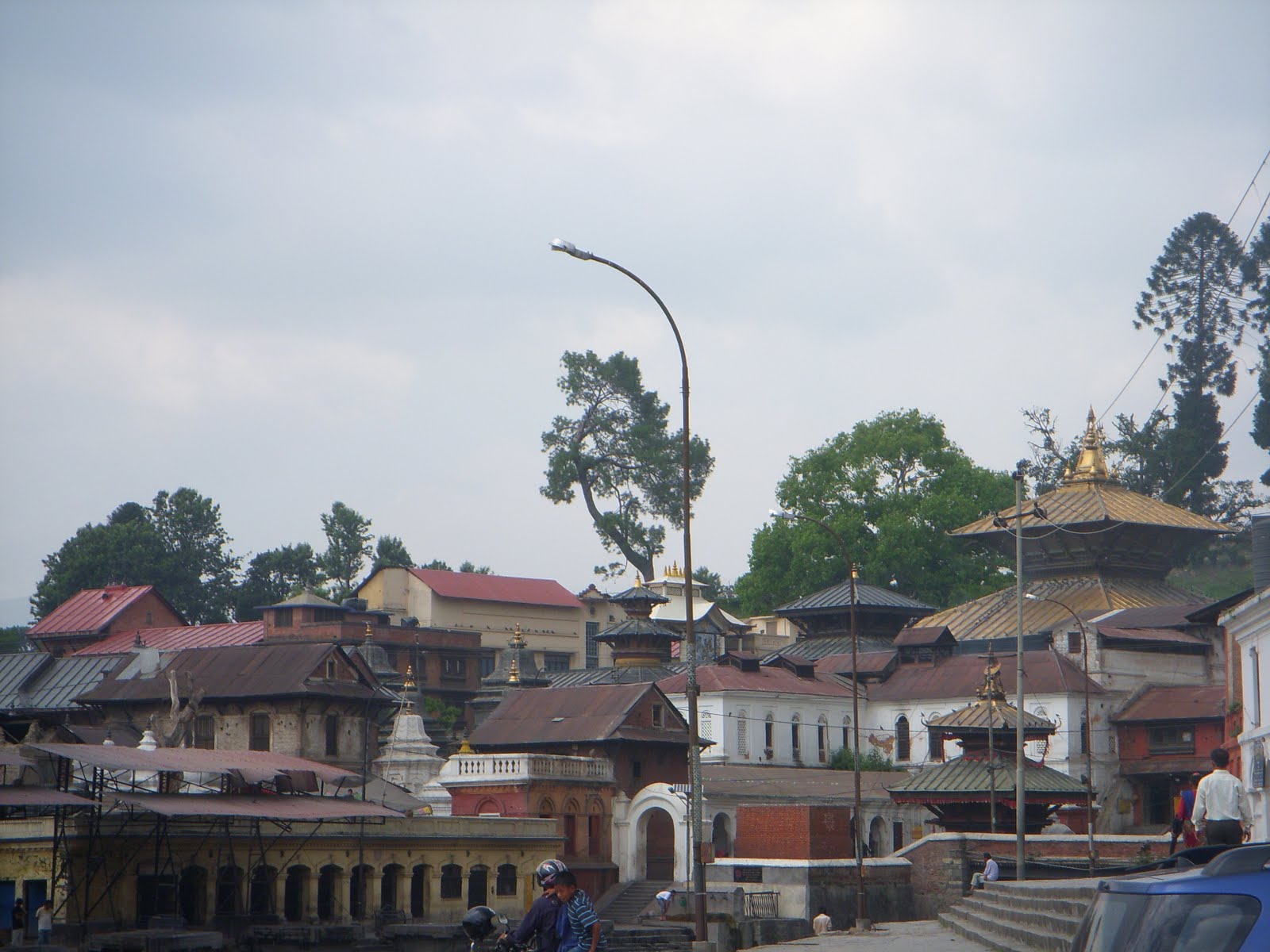
It is called the “holy area”.  It looked like a holey area.  We were short on time and so we had to run through the sites.  We ran by the peddlers and they ran after us.  One woman followed Jess around the entire time in the temple asking her to purchase ugly jewelry.  I finally got firm with her that she was not interested.  It was the first time I have had to raise my voice over here.  The holy area was odd.  Only those born in Nepal or India are considered Hindu by the temple authorities, and all others are not allowed to enter the temple premises We snapped our pictures and looked at the temple from the river bank.

A crowd had gathered on the bridges overlooking Bagmati River, a tributary to the Holy Ganges River.  They were looking at nothing, or so it seemed.  We often take it for granted that we can speak freely in English if we talk fast and use our thesaurus.  And so were talking about the weird gathering of people staring at the dirty holler below when a young man of fourteen started to tell us what we were looking at, and why we were being jerks.  Suryabas told us that we were watching the incineration of a rich man who recently passed at the hospice home located on-site because before an elder dies the Hindus believe they should spend their last days in the holiest of places.  We employed him as our guide and he explained the process of purifying the man before he is burned up.  He explained the cremation for a poor person cost 5,000r, and is done on the other side of the bridge.  The cremation for a rich person costs 10,000r, and 25,000r for a person with official status.  The difference in prices accounts for the different types of wood used for the fire.  First, the person is washed in the holy water.  Water is poured in his mouth and on his feet by his relatives.  Then, they take his cloths, throw them in the river, lay him on wooden blocks and set him on fire.  If it is the father, the eldest son starts the fire, and if it is the mother, the youngest son.  He informed about 40 cremations are performed at the river per day.  We soon realized Suryabas was a very intelligent young boy, who split his time between school and hanging out at the temple to further his education.  He told us he wanted to be a doctor and we told him his chances seemed high and to keep studying.   I was so struck by his intelligence and gregariousness that I asked a million questions just to see if he could answer them smartly.  He showed us caves carved out of the cliff side built by college students who wanted to devote their time to religious study and meditation.  He explained a series of painted murals portraying many of the different Hindu gods, painted by an Italian woman.  He pointed out the Holy Men, who spend their lives at the temple, eating and sleeping there, devoting themselves to Hindu.  They had their entire faces painted in red, white, and orange, their hair was in dreadlocks and you could snap a picture with them for a small fee, we opted out.  Our time was up though, and we had to go to the airport. Last I saw of the cremation service was the man covered in grass and on fire. 


We made it to the airport in no time.  We got through customs and security in no time.  We got on the plane in no time and then we sat there for three hours.  That mean sun finally set and our captain said our flight had been canceled.  A hole in the runway had caused the delay, and Indian regulations denying one-eyed pilots the ability to fly at night had canceled our flight after sun down. Now the circus starts.

Frantic and angry passengers began shouting; I mean they were really shouting, as if they meant to pick a fight.  Spice Jet staff were hiding behind their counters and in concession stands avoiding our wrath.  Chaos ensued.  Jess and I were lucky to find ourselves among the patient and bilingual crowd. Allein, a travel agent from Delhi, and family of three with a former Marine (Indian) and daughter on her way to Jindal Global Law School, kept us company and saved us from the false profits.  With their help we managed to find our way to some busses and eventually to the #1 OK Hotel in Thamel.  Despite its name, it was not ok.  But, it was free.  Jess and I did our best to not touch anything, at all.  I took first bug watch, but when Jess didn’t wake up for second shift, I volunteered to keep us safe from the gigantic roaches all night. 


We woke up at 6am because that is when Spice Jet said the busses were coming to get us.   They must have meant 8 am because that is when the busses came.  At the airport, again, we made it through without issue.  Back on the plane, again, things seemed promising.  After a half an hour, passengers, all of them men, began to shout and congregate around the cockpit.  We could not hear exactly what was said, but it was very tense.  Jess and I commented to each other that if what was happening on the plane, happened in the U.S., someone would be deplaned without the aid of their arms or legs.  Quickly the men broke their angry huddle and marched back to their seats triumphant fools.  The plane was moving.  And there was no shortage of credit due those imbeciles.  One fool sat right in front of Jess and I and was applauded as a hero for his rude treatment of the flight crew.  When he asked us to sign his letter of complaint written in crayon, Jess and I turned our noses up and motioned “be gone” with our left hands. We do not suffer fools. 

Our trip to Nepal was really fun.  Both of us want to go back and consider this closing a sincere invitation to any reader who wants to come back with us.  The people are nice in their way, shopping is cheap, the food is relatively safe, and the scenery is amazing.  Our pictures are poor representations to what Nepal looks like to the naked eye.  It feels like a wild place, but just enough to be interesting without being too scary.  We are very glad we went and managed to avoid getting sick, despite a forewarning.